Introduction
For over a decade, FAANG (Facebook, Apple, Amazon, Netflix, Google) represented the absolute pinnacle of technology, prestige, and career aspiration. To land a software engineering role at any of these companies was the gold standard—bringing high compensation, massive scale, and a badge of honor on your resume.
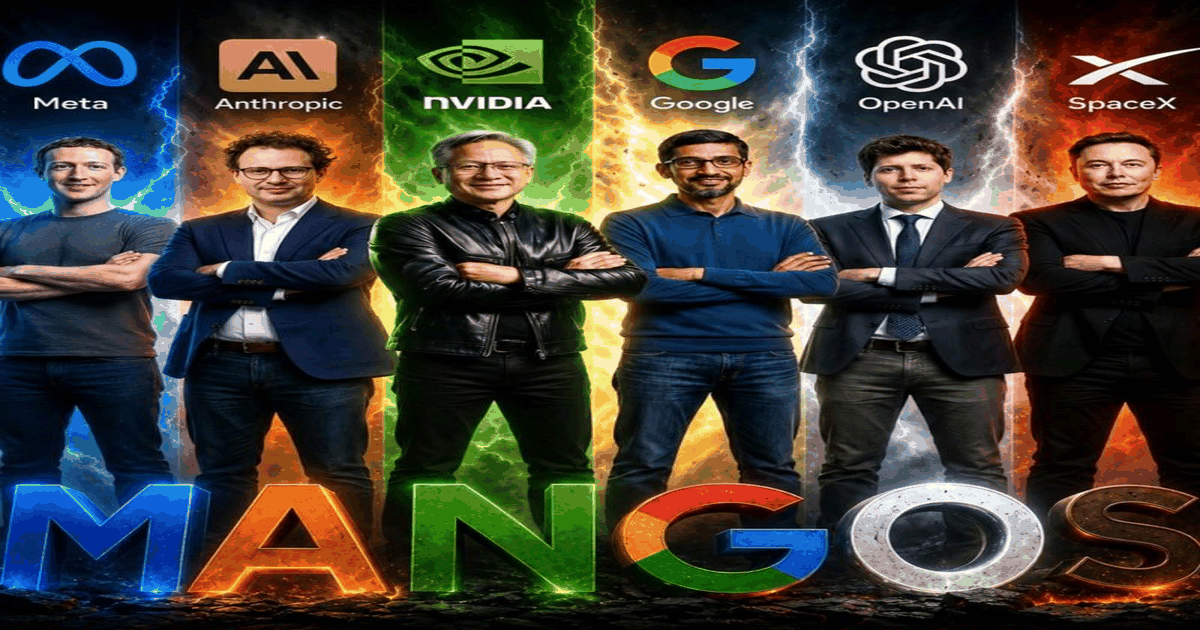
However, in 2026, the technology landscape has undergone a tectonic shift. A new acronym has emerged from developer circles and venture capitalist boards: MANGOS.
Representing the frontrunners of the Artificial Intelligence and next-generation deep-tech revolutions, MANGOS stands for:
- Meta
- Anthropic
- Nvidia
- Google
- OpenAI
- SpaceX
This transition isn't just about a change of letters; it represents a fundamental paradigm shift in how value is created, how technology is built, and where the next decade's defining platforms will live.
What is MANGOS?
The term "MANGOS" defines the companies that are actively building the intelligent infrastructure of tomorrow. Let's look at the key players:
1. Meta & Google (The FAANG Survivors)
Meta and Google are the only two giants that successfully bridged the gap from the social/mobile era to the AI era.
- Meta pivoted incredibly hard into open-source AI, releasing the LLaMA model family, which has become the foundation of the open-source developer ecosystem.
- Google continues to be a research powerhouse with DeepMind, integrating Gemini across its billions of users and building custom TPUs (Tensor Processing Units) to bypass external hardware bottlenecks.
2. Nvidia & OpenAI (The Infrastructure & Model Leaders)
- Nvidia is the bedrock of the entire AI economy. By providing the GPU hardware (from H100s to Blackwell B200s and beyond) and the proprietary CUDA software platform, they have built an almost impenetrable moat.
- OpenAI kickstarted the generative AI boom. With ChatGPT, GPT-4, and their continuous research into reasoning and agentic models, they define the state of the art in foundation model capabilities.
3. Anthropic (The Safety & Research Pioneers)
Co-founded by former OpenAI researchers, Anthropic has established itself as the leading voice in AI safety and alignment while pushing the envelope in intelligence with their Claude model series. Their focus on long context windows, computer use, and enterprise reliability has made them a developer favorite.
4. SpaceX (The Frontier of Deep Tech)
While other MANGOS companies build digital intelligence, SpaceX represents the frontier of physical infrastructure. By solving massive engineering challenges in orbit (Starship, reusable rockets) and establishing the Starlink satellite constellation, they are laying the hardware foundation for global connectivity and space exploration.
Why the Shift is Happening
Why are developers and investors turning away from traditional giants like Netflix and Amazon retail to focus on MANGOS?
1. AI is the New Platform Layer
In tech history, value is captured when a new platform layer is established:
- The 1990s belonged to PC/Desktop (Microsoft).
- The 2000s belonged to Web/Search (Google, Amazon).
- The 2010s belonged to Mobile & Cloud (Apple, AWS, Meta).
- The 2020s belong to AI Foundational Models and GPU Compute.
Traditional companies that are merely consumers of AI tools (like Netflix or traditional retail e-commerce) do not capture the massive platform rents that infrastructure builders (Nvidia) or foundation model creators (OpenAI, Anthropic) do.
2. The Shift in the "Dream Job" Dynamic
For software engineers, the daily tasks at traditional FAANG companies have increasingly moved into maintenance mode: optimizing existing ad flows, scaling mature databases, or maintaining legacy web/mobile codebases.
In contrast, joining a MANGOS company places engineers at the absolute frontier of technology:
- Training models on thousands of GPUs.
- Writing low-level GPU kernels using Triton or CUDA.
- Designing next-generation agentic loops and reinforcement learning feedback pipelines.
- Building rockets that land themselves on floating barges.
The sense of agency, speed of iteration, and potential equity upside at high-growth AI companies far eclipse the stable, slow-paced corporate environment of legacy giants.
The Engineer's Toolkit for the MANGOS Era
To thrive in this new era, developers need to pivot their skill sets. The standard stack of building REST APIs, React components, and relational database migrations is no longer enough to set you apart.
The modern MANGOS engineer focuses on:
- Foundational AI Concepts
- Understanding tokenization, attention mechanisms, context windows, and embeddings.
- Fine-tuning techniques like LoRA (Low-Rank Adaptation) and RLHF.
- AI Infrastructure & Tooling
- High proficiency in PyTorch and Hugging Face.
- Experience with vector databases (Pinecone, pgvector) and RAG (Retrieval-Augmented Generation) architectures.
- Hardware Acceleration
- Understanding GPU memory bandwidth, compute constraints, and floating-point precision (FP8, FP16, BF16).
- Knowledge of Triton, CUDA, or compiler optimizations.
Conclusion
The shift from FAANG to MANGOS is a healthy evolution of the tech industry. It marks the transition from the attention economy (where success was measured by screen time, social engagement, and ad clicks) to the intelligence and infrastructure economy (where success is measured by reasoning capabilities, compute efficiency, and physical engineering breakthroughs).
Whether you are an aspiring student, a senior software developer, or an investor, aligning your focus with the MANGOS paradigm is the surest way to build for the future.
The scale of compute is growing at a rate of 10x per year. We are no longer writing programs, we are growing them.
The journey is just beginning.