Introduction
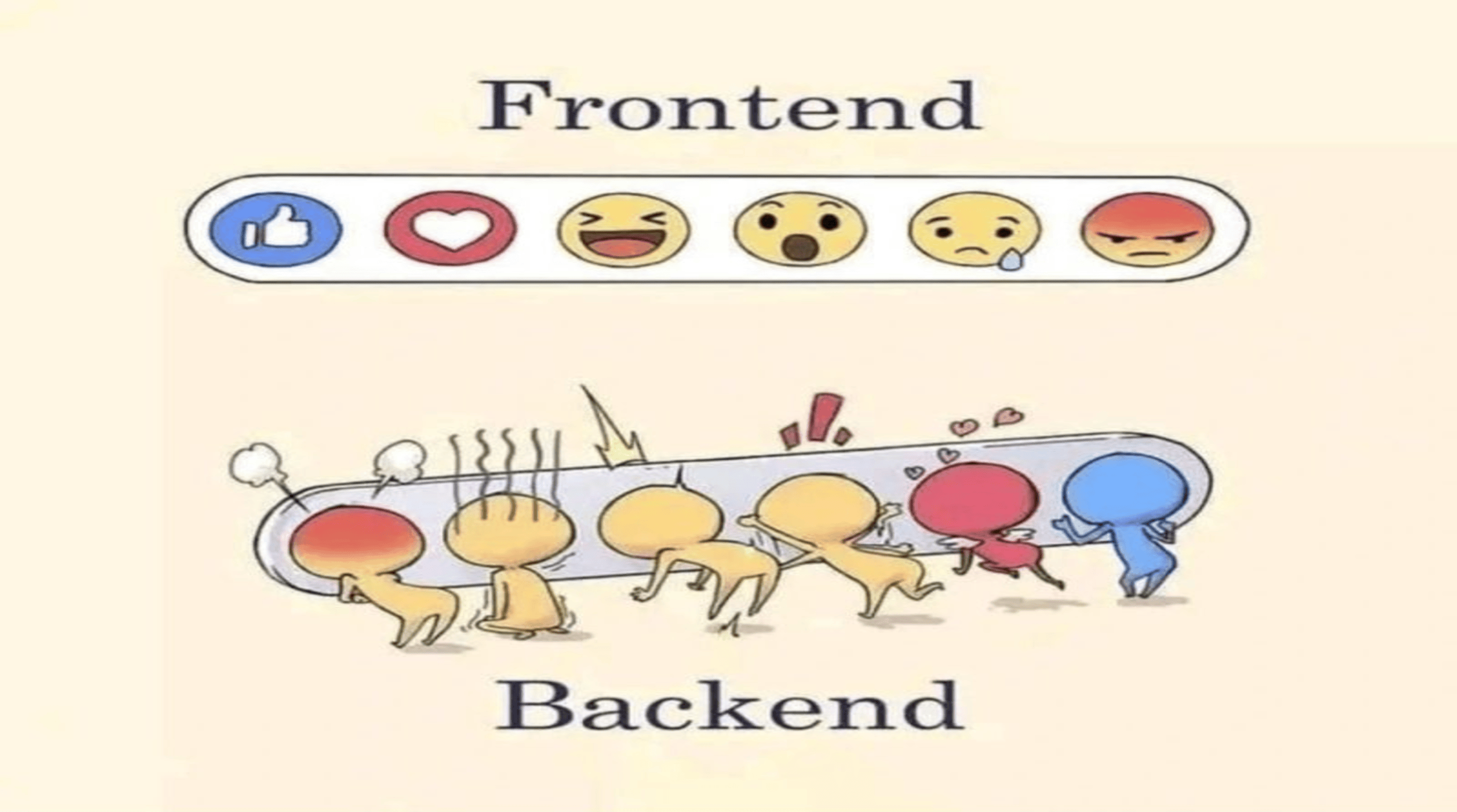
Ever tapped "Like" on a post without a second thought? It barely registers as an action — one quick tap, and it's done. That's kind of the point: the whole experience is designed to feel like nothing.
But "nothing" is doing a lot of work behind the scenes. That single tap sets off a chain of systems — servers, databases, caching layers, and real-time updates — all coordinating in milliseconds to make the interaction feel instant. It's one of the things I find most interesting about building software: the simpler something looks to the user, the more engineering usually went into making it feel that way.
That's what I want to unpack here — how frontend and backend development come together behind even the smallest, most "obvious" features we use every day.
In this article, we'll take a closer look at what really happens when you click a Like button and explore how frontend and backend systems collaborate to deliver the seamless digital experiences we use every day.
What is Frontend Development?
Frontend development (also called client-side development) is everything the user sees, touches, and interacts with in a web application. It's the visual layer — the buttons, the layouts, the animations, the typography, and the colors.
Core Frontend Technologies
- HTML — The skeleton that structures content on a page.
- CSS — The styling layer that controls layout, colors, fonts, and responsiveness.
- JavaScript — The brain that adds interactivity, handles user events, and makes the page dynamic.
Modern Frontend Frameworks
Today's frontend developers rarely write plain HTML/CSS/JS. Instead, they leverage powerful frameworks and libraries:
- React — Component-based UI library by Meta, powering millions of web apps.
- Next.js — A React framework for server-side rendering, routing, and full-stack capabilities.
- Vue.js — A progressive framework known for its gentle learning curve.
- Angular — Google's enterprise-grade framework for building complex SPAs.
The frontend developer's job is to make the user experience feel seamless, fast, and intuitive. When you see six reaction buttons (👍 ❤️ 😂 😮 😢 😡) on a social media post, the frontend is responsible for rendering them beautifully, animating the hover states, and sending your click to the server.
What is Backend Development?
If the frontend is the storefront window, the backend is the entire warehouse, logistics chain, and security system behind it. Backend development (or server-side development) handles the logic, data management, authentication, and infrastructure that power a web application.
What the Backend Actually Does
Taking Rangish's reaction button example, here's what the backend must handle when you click "Like":
- Database Design — Structuring tables to store reactions (which user reacted, which post, which emoji, and when).
- API Construction — Building secure REST or GraphQL endpoints that the frontend can call.
- User Authentication — Verifying that the person clicking "Like" is actually logged in and authorized.
- Duplicate Prevention — Ensuring a user can't "Like" the same post 500 times.
- Data Storage & Updates — Writing the reaction to the database and updating aggregate counts in real time.
- Concurrency Handling — Managing thousands of simultaneous reactions without data corruption or race conditions.
- Performance Optimization — Using caching (Redis, CDN layers) to serve reaction counts without hammering the database.
- Real-Time Delivery — Pushing updated reaction counts back to all connected clients via WebSockets or Server-Sent Events.
That's eight distinct engineering challenges — all triggered by a single button click.
Core Backend Technologies
- Node.js / Express — JavaScript runtime and framework for building fast, scalable APIs.
- Python / Django / Flask — Popular choices for data-heavy and ML-integrated backends.
- Java / Spring Boot — Enterprise-grade backend frameworks.
- Databases — PostgreSQL, MongoDB, MySQL, Redis for data persistence and caching.
- Cloud Infrastructure — AWS, Google Cloud, Azure for hosting, scaling, and deployment.
The Iceberg Analogy
Think of any web application as an iceberg:
- The 10% above water is the frontend — the beautiful UI, the smooth animations, the pixel-perfect design.
- The 90% below water is the backend — the APIs, databases, authentication, security, caching, error handling, logging, monitoring, and deployment pipelines.
Users only interact with the tip of the iceberg. They never see the thousands of lines of backend code that validate their input, protect their data, and ensure the system doesn't collapse under load. This is precisely why Rangish's post struck a chord — it visualized this invisible complexity in a way that both developers and non-developers could instantly understand.
How Frontend and Backend Work Together
Modern web applications don't exist in silos. The frontend and backend communicate through a well-defined contract, typically using APIs (Application Programming Interfaces).
The Request-Response Cycle
Here's a simplified flow of what happens when you click a "Like" button:
- User Action — You tap the ❤️ button on the frontend.
- Frontend Request — JavaScript sends an HTTP POST request to the backend API:
POST /api/reactionswith payload{ postId: "123", type: "heart" }. - Backend Processing — The server authenticates you, validates the request, checks for duplicates, writes the reaction to the database, and updates the count.
- Backend Response — The server responds with
{ success: true, newCount: 1,248 }. - Frontend Update — JavaScript receives the response, updates the heart count from 1,247 to 1,248, and plays a subtle animation.
This entire cycle happens in under 200 milliseconds — fast enough to feel instantaneous to the user. But behind that speed lies careful engineering on both sides.
Full-Stack Development
Developers who work across both the frontend and backend are called full-stack developers. They understand the complete picture — from pixel-perfect UI to database query optimization. The MERN stack (MongoDB, Express, React, Node.js) is one of the most popular full-stack combinations because it uses JavaScript across the entire application.
Why This Matters
Understanding the frontend-backend divide isn't just academic — it has real implications for anyone involved in building or managing software:
For Aspiring Developers
Knowing which side excites you helps you choose a career path. Love visual design and user interaction? Lean into frontend. Fascinated by systems, data, and architecture? Backend might be your calling.
For Product Managers & Designers
That "simple" feature request — "Can we just add a reaction button?" — is never as simple as it sounds. Understanding the backend complexity helps set realistic timelines and fosters better collaboration with engineering teams.
For Business Leaders
The hidden backend complexity is where the majority of development time and infrastructure cost lives. Investing in backend engineering, monitoring, and scalability isn't glamorous, but it's what keeps your product reliable under growth.
The Teamwork Behind Great Software
As Rangish perfectly summarized: "This is one of the reasons software development is a team effort. Great user experiences are built when frontend and backend developers work together."
No single developer — no matter how skilled — can master every layer of a modern web application. Frontend developers bring empathy for the user, an eye for design, and expertise in browser behavior. Backend developers bring systems thinking, security awareness, and the ability to architect for scale.
The best products emerge when these two worlds collaborate closely, communicating through clear API contracts, shared documentation, and mutual respect for each other's craft.
Conclusion
The next time you tap a reaction button, submit a form, or scroll through an infinite feed, take a moment to appreciate the engineering iceberg beneath the surface. That polished, effortless interaction you enjoy is the product of meticulous database design, secure API development, authentication logic, concurrency management, and performance optimization — all working silently in the background.
Web development is a symphony, and every great user experience requires both the visible instruments on stage (frontend) and the unseen orchestra in the pit (backend) playing in perfect harmony.
Every 'simple' button usually has a complex story behind it.
The beauty of software engineering is that when it's done right, you never notice the complexity at all.